Cutaway and Insert Shots as Continuity Solutions
Cutaways leave a scene to mask edits, while inserts stay within it to clarify essential details.
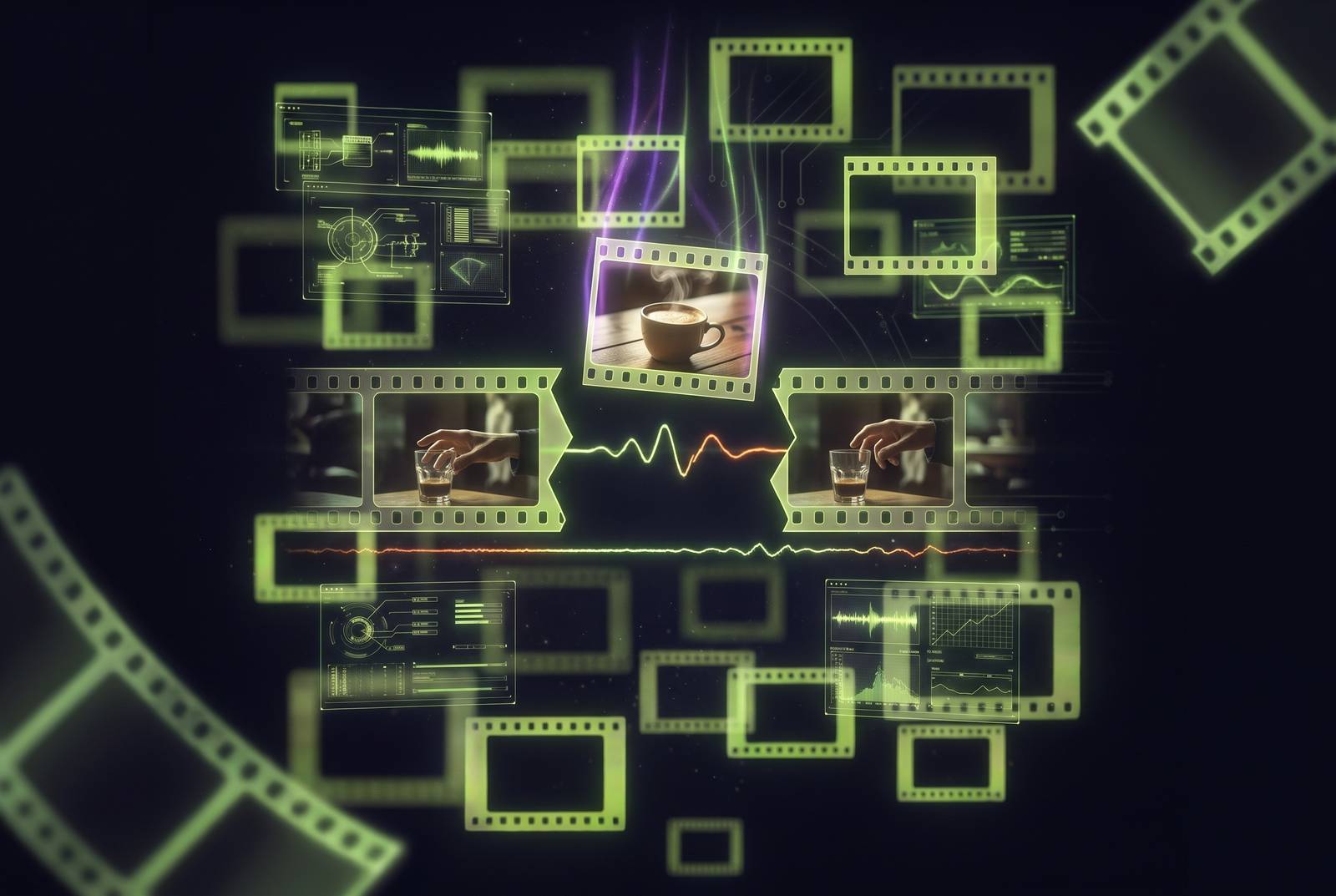
Cutaway and insert shots solve different continuity problems because they change the viewer’s relationship to a scene in different ways. A cutaway creates a break from the main action, while an insert directs attention within it. Choosing between them begins with diagnosing what has failed, whether that is continuity of time, spatial orientation, or access to an essential detail.
Why cutaway and insert shots exist as distinct editorial tools
A cutaway interrupts the main action with a view of something outside it, then returns. Its defining feature is departure, either spatial or temporal. In an interview, for example, a shot of the process being described takes the viewer away from the speaker rather than offering another view of the speaker’s immediate surroundings. That departure creates room for an edit in the underlying interview. The intervening image is not merely decoration placed over a seam.
An insert, also called a cut-in, works in the opposite direction. It stays within the scene and isolates something already present in the wider shot. A close-up of a message makes its text readable without moving the audience into another setting or another time. Where the cutaway interrupts the viewer’s continuous view of an action, the insert narrows that view.
The distinction therefore depends on the shot’s relationship to the main action. What does the new image do to the viewer’s connection with the main action? A close view is not automatically an insert if its subject belongs outside that action. Both tools can be specified in a screenplay, although most inserts are directed as pickups or second-unit coverage to fill editing gaps. That reactive use helps explain why the two are often treated as interchangeable repair material, even though they offer different kinds of repair.
How the jump cut problem in interview and dialogue editing specifically demands a cutaway, not an insert
Removing a stumble, false start, or overlong passage from a continuous interview take creates a straightforward visual problem. The words may join cleanly, but the subject’s head suddenly changes position between the pieces that remain. In documentary, corporate, and interview-led work, this problem recurs throughout the assembly, making interview repair the highest-volume use of B-roll cutaways on most such projects.
The cutaway removes the subject from view across that join. During the break, the audience has something else to follow, so the return to a changed position can read as elapsed time. The crucial separation is from the subject’s positional continuity. An insert that preserves the same action and spatial references does not provide that separation and can draw attention to the mismatch instead.
A reaction shot offers a particularly useful form of departure. The interviewer listening or nodding shifts attention to the other side of the conversation without asking the viewer to abandon its social context. It exits the speaker’s action while potentially remaining in the room. This explains why a reaction shot can function as a cutaway even though it remains part of the same encounter.
A reaction shot that was never captured is not available simply because the assembly needs one. B-roll that fits the scene also depends on what was shot. The number of seams that can be hidden cleanly therefore depends partly on what the shoot supplied and partly on how resourcefully the editor rearranges it.
When screen direction breaks, a cutaway is the tool that resets the audience's spatial map
Crossing the axis of action creates a different failure. A character moving left can suddenly appear to move right, leaving the viewer unsure how the shots connect in space. Keeping the camera on one side of the axis of action preserves a consistent relationship between camera position and screen direction. When that relationship breaks, a close-up insert does not establish a new orientation merely by making the image tighter.
Here, the cutaway interrupts the spatial frame the audience has been tracking, allowing the return to establish a fresh orientation. That is a harder task than concealing a change in head position because the audience needs a usable relationship between people, movement, and surroundings.
A neutral shot provides another route through the problem. Someone moving directly toward or away from the camera has no left-right screen direction, so that shot can sit between views that would otherwise clash. It remains within the scene. Both approaches can help the viewer get their bearings again, while flipping an image in post is a last resort.
Eyelines make the diagnosis more demanding still. If a glance points toward the wrong side of the frame after an axis crossing, cutting to its supposed target can reinforce the faulty geography. The audience is being asked to connect two incompatible directions. Editors need to resolve the axis before using a look and its target to explain the scene, rather than assuming any intervening image will repair the relationship.
Where the insert solves what a cutaway cannot: directing attention within a scene to control what the audience understands
An intact scene can remain difficult to understand even when every movement and screen direction matches. The viewer may see what is happening generally without seeing the detail on which its meaning depends. This is the insert’s distinct problem to solve. Leaving the scene would divert attention from the missing information, whereas moving closer within it makes that information available.
Consider a medium shot of a scientist pipetting liquid into vials. The image establishes activity in the lab, but a separately filmed close-up of the scientist’s fingers or fingertip isolates the specific action. The audience need not relocate to understand it. The insert preserves the surrounding scene while changing which part of it receives attention, turning visible activity into a more precise account of what is happening.
A message may already be present in the medium shot without its words being available to the audience. Presence is not the same as legibility. The insert closes that gap, but its placement also determines when the information becomes part of the viewer’s understanding. Cutting too early can remove suspense, while holding too long can interrupt momentum.
Composition shapes the emphasis after timing establishes the moment. Placement on rule-of-thirds intersections, a macro lens for flat product detail, or a slightly wider view for tactile context changes how the detail is presented. Static framing and subtle movement also offer different ways of directing attention. The close-up must reveal the needed information at the point when the scene needs it.
How pacing and format determine which tool to reach for, and how often
A shot can solve the visible seam and still damage the sequence. As well as filling the gap, the shot must have a length and tone that fit the rhythm around it. A documentary built around contemplative holds of several seconds can absorb an atmospheric landscape or empty room. The same pause can feel like a dead stop in a fast-cut social clip or corporate explainer.
Wedding videography shows how repair and pacing can work together. A cutaway to venue details or décor can hide a cut while giving the film breathing room and a sense of place. Those functions explain why that particular departure belongs in the film. Its value comes from what the pause contributes as well as what it conceals.
This raises a useful question about every available cutaway. Is it there because the sequence needs the departure, or because the footage happens to exist? Availability alone is a weak editorial reason. Repeated cutaways without a clear purpose dilute their effect and can make the sequence feel as though it is concealing an unresolved structural problem.
Inserts, too, can give a detail too much weight. The audience may need to see a detail only briefly, especially when the rest of the edit moves quickly. How long the audience needs to understand the detail should guide the hold, even if more of the shot is usable. A technically appropriate image used at the wrong moment can become its own continuity failure, interrupting the flow of thought.
What AI-assisted editing can and cannot do when identifying where cutaways and inserts are needed
AI-assisted footage analysis addresses an earlier layer of this work. Semantic indexing can link timestamps with plot, emotion, and dialogue metadata, making likely jump cuts or unresolved details easier to locate. A searchable library can also find B-roll whose metadata matches what is being discussed. These are detection and retrieval tasks. They make it easier to find a problem and shots that might fix it, while leaving the choice of image for the finished sequence open.
The CutCraft benchmark, introduced by researchers at Alibaba Group, Shanghai Jiao Tong University, Fudan University, UT Austin, and the Institute of Software, Chinese Academy of Sciences, identifies a related distinction in multi-shot generation systems. It consistently finds a gap between making sequences that hold together and carrying out specific editing techniques. Transition timing, shot structure, J-cuts and L-cuts take more than putting believable images one after another. The benchmark also finds that how good a sequence looks has only a weak link to how well it follows the editing techniques.
That finding concerns generation rather than footage retrieval, but it clarifies why the two layers should not be confused. Recognizing a coherent sequence is different from choosing the transition that gives it the intended meaning. Natural-language video control pipelines currently depend on metadata and transcript layers as proxies for the footage itself. Those layers describe what was said and when rather than directly resolving the frame’s spatial or emotional content. Matching the topic alone cannot show whether a shot fixes an axis problem or fits a performance.
Tools that analyze emotion, pacing, and narrative structure and export into video editing software let editors begin with a structural read of the collection. The placement decision still remains with the editor. A flagged interview join might call for a reaction shot, an atmospheric departure, or a hard cut that acknowledges the edit. Likewise, after identifying a missing detail, the editor still must choose between sourcing and generating its insert.
How knowing which problem you have tells you which shot to reach for
Diagnosing what the audience needs comes before searching through B-roll. What must change for the audience to follow the sequence? If removed time creates a visible snap, the edit needs a break from positional comparison. If screen direction clashes, it needs a neutral bridge or a departure that lets the viewer get their bearings again. If the scene is coherent but its essential detail remains unreadable, it needs closer attention within the existing frame.
The same reasoning applies to performance gaps, though they differ from positional jumps. A cutaway can bridge takes with different performance registers by taking both out of view during the transition. The audience returns after an intervening beat rather than comparing the performances across a direct join. Concealing the seam is not enough if the chosen image introduces a new tonal mismatch.
For an editor stuck in an assembly, the useful distinction is therefore between departure, reorientation, and emphasis. Each describes what the audience needs. That need determines which coverage would offer a real option and which would only occupy time. Missing coverage constrains the answer, however accurately the problem has been diagnosed. Intentional editing starts before the camera rolls.