J-Cuts and L-Cuts as Audio Editing Devices
These asymmetrical cuts replicate how humans naturally perceive sound and sight.
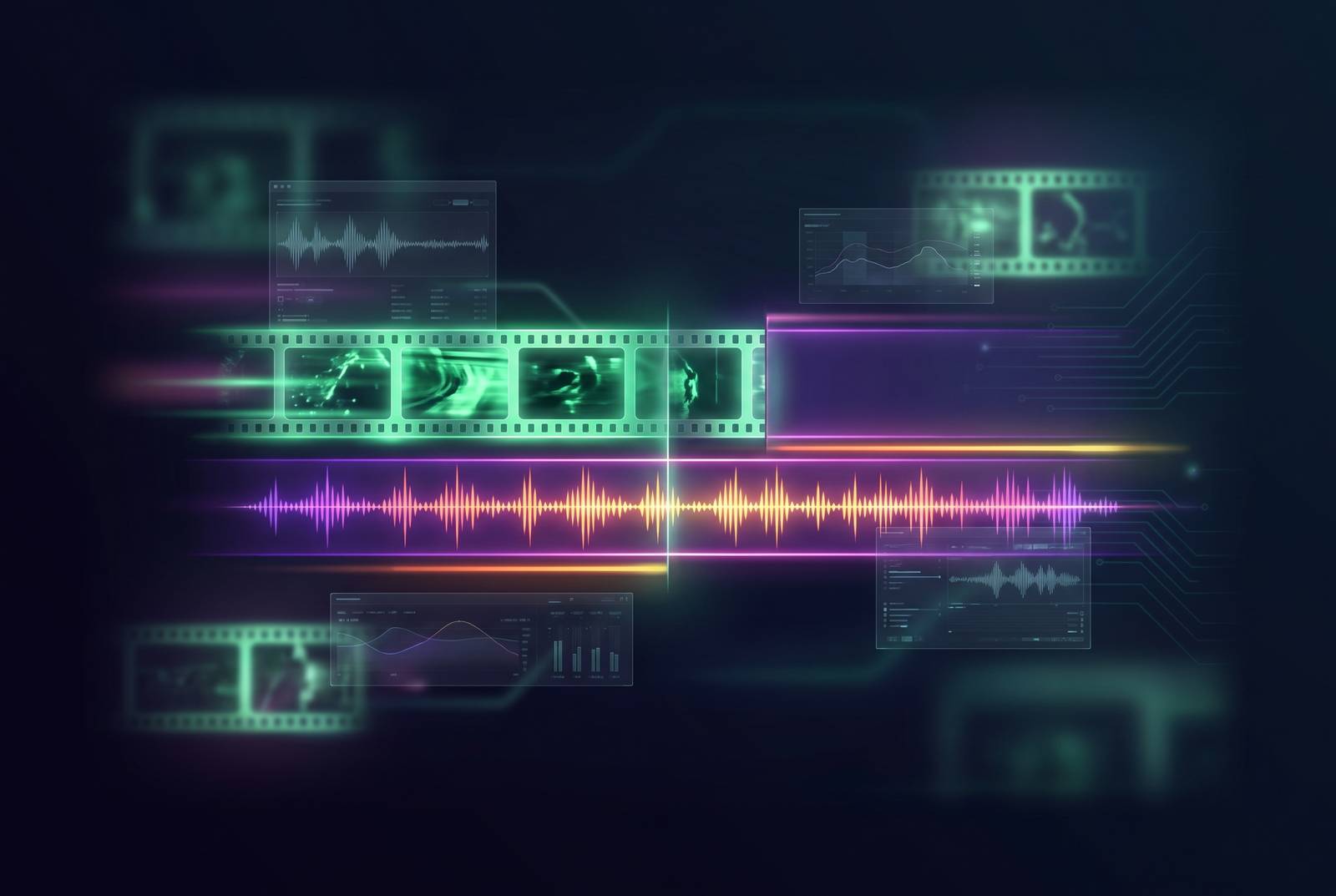
J-cuts and L-cuts are edits where the sound and the picture change at different moments.
What J-cuts and L-cuts are
A split edit is any transition where the audio cut point and the video cut point land at different moments in time, which turns the audio-video relationship into a deliberate choice the editor makes. In a J-cut, audio from the next clip begins before its picture appears: the audio leads, and the eye catches up to what the ear has already registered. In an L-cut, audio from the current clip continues after the picture has already cut to the next clip: the audio trails, holding the viewer in the previous moment even as the image has moved on.
The names are not arbitrary. L, audio extends right, you hear it after. Every claim in the rest of this piece builds on that single image.
Why audio and picture separate naturally in human perception
The reason J-cuts and L-cuts work has less to do with film convention than with how human attention is built. These edits succeed because they replicate the way people actually perceive the world moment to moment, not because editors agreed at some point that this is how cuts should look. A J-cut replays that exact sequence, letting the audience hear before they see, which makes the cut feel like a discovery.
An L-cut replays the complementary experience. Someone has already turned away from a conversation, but the voice behind them has not finished, so the ear stays anchored to a moment the eye has already left. Both situations happen constantly in daily life, and because they happen constantly, they register as natural.
A straight cut, where audio and video change at the exact same frame, asks both senses to reorient at once, a demand ordinary experience rarely makes. This is the foundation of what editors call invisible editing, cuts the audience feels in the pacing and the emotion without ever consciously registering the cut itself. Only the position of the audio boundary did.
Tools built to analyze footage can help editors spot these moments faster. Ponder, for instance, reads footage for emotional tone, pacing, and audio continuity. It can flag places where audio naturally wants to lead or lag before an editor has reviewed the material frame by frame. That kind of detection does not replace the editor's judgment about what to do with the moment, but it does mean fewer genuine split-edit opportunities get missed simply because nobody had time to scrub through hours of footage listening for them.
The opposite emotional work J-cuts and L-cuts do
It would be convenient to treat J-cuts and L-cuts as two versions of the same smoothing tool, but they are not interchangeable, because they produce opposite perceptual effects. The real question an editor faces at each cut point is not simply whether to use a split edit but which direction the story needs to move: forward, or still.
The J-cut generates anticipation and forward momentum. The audience experience is a kind of forward pull: hear it, then see it.
The L-cut does something close to the opposite. Letting audio linger slows the perceived pace and holds the audience inside a feeling. L-cuts show up so often when a listener's reaction matters more than the next line of dialogue, when music needs to carry across a visual transition, or when the emotional residue of one scene needs to survive into the next.
A single dialogue exchange makes the contrast concrete. Person A finishes a powerful line. A straight cut at that same moment would show the same two shots in the same order, but it could not produce that effect, because the emotional work depends entirely on the overlap.
The same logic applies across a hard time jump. An L-cut that lets audio from the earlier moment bleed briefly into the new period creates the sense that the past has not fully released its hold. The technique turns up so often in memory sequences and montages where emotional continuity needs to survive a visual break.
There is also a subtler function at work, one easy to overlook: subtext. Because split edits are asynchronous by design, they generate meaning through juxtaposition. One might argue this is the single most underused application of the technique, since it lets the edit itself carry narrative information that would otherwise require an extra line of dialogue or a reaction shot held a beat too long.
As a general orientation rather than a rule: a J-cut leads into a new speaker, scene, or sound with motivation instead of abruptness, and an L-cut stays with a reaction, lets a line breathe, or carries a feeling across a visual cut. Choosing between them means asking what effect the moment needs, not running down a checklist of when each is technically correct.
How split edits shape dialogue scenes
Dialogue is where this choice gets tested most often, because dialogue scenes are the most common place split edits appear and the place their absence is most noticeable. Without split edits, a conversation defaults to mechanical alternation between speakers, cutting back and forth in a pattern that mimics the structure of a conversation without capturing the experience of one.
A standard cut between speakers forces the audience to reorient both ear and eye at the same instant on every exchange, drawing attention to the edit itself. L-cuts fix this: cutting to a listener's face while the speaker's words are still audible shows the audience how a line lands. J-cuts handle the opposite job, introducing a new speaker's voice a beat before the picture cuts to them, so the arrival of a new voice signals.
In a well-cut dialogue scene, J-cuts and L-cuts layer so densely that the audience perceives one continuous flow rather than a series of cuts, because no single moment forces both senses to reorient simultaneously. Only the position of the audio boundaries did.
Two professional examples make the principle visible. In The Empire Strikes Back, after Vader's line "I am your father," the picture cuts to Luke's stunned reaction while the dialogue is still finishing, an L-cut that holds the audience inside the full weight of the moment.
How split edit logic applies across formats
The underlying principle, keep at least one sensory channel continuous across a cut, holds across every format, but each format has a dominant way of expressing it.
Documentary and interview work lean heavily on J-cuts as scene-transition devices: a subject's voice from an upcoming interview segment, heard over the tail of a preceding visual sequence, threads two segments together without a hard break. In talking-head content, the pair typically arrives in sequence: entering a B-roll passage is an L-cut, since the audio continues while the picture changes first, and exiting that passage is frequently a J-cut, with narration continuing until the talking head returns.
Wedding videography carries its own pressure, because vows, toasts, and officiant audio are the irreplaceable moments a couple will return to for decades, and clarity there is non-negotiable. J-cuts, L-cuts, and careful audio ducking are the tools that hold these competing audio layers in balance while keeping the one thing that matters, the words themselves, clear.
Real estate video depends almost entirely on L-cut logic. Narration has to run unbroken while the picture cuts from room to room, because the voiceover is describing what the viewer is looking at, and breaking that connection even briefly costs the tour its spatial logic. The job is to show how rooms connect and move a viewer through a property without confusion, and stable footage, readable sequencing, and unbroken narration are what make that possible.
YouTube and explainer video run on the same L-cut backbone: narration continues unbroken while the picture cuts away to demo footage, by far the most common split edit in the format. Because the narrator's voice is the primary thread holding an explainer together, breaking that narration at every visual cut would make the edit feel chopped into pieces, and the L-cut is precisely what prevents that from happening.
Where craft judgment is irreplaceable
A split edit placed at the wrong moment doesn't fail because the technique is flawed. It fails because the judgment about when to hold a moment and when to move past it belongs entirely to a person reading emotional context, not to a formula.
Restraint matters as much as execution. Split edits carry the most power when reserved for moments where the audio-visual offset adds real narrative value, and applied reflexively to every cut, they stop shaping the scene and start flattening it. Get the content right first, deciding which moments actually belong in the edit, then smooth the rhythm with J-cuts and L-cuts, and only then turn to surface polish, because reversing that order wastes effort, since polish applied to the wrong content still produces the wrong content.
One diagnostic check cuts through most uncertainty: play the edit back with eyes closed. A stiff or abrupt audio cut announces itself to the ear long before the eye would ever catch a problem with the picture. And not every cut should be softened. Action sequences, comedy beats, and moments built to land with a jolt are often undercut by a split edit that smooths away the exact sharpness the scene needs.
What AI-assisted editing can and cannot do
AI tools can strip away the mechanical groundwork that comes before any split-edit decision gets made: organizing footage, transcribing dialogue, detecting scene boundaries, assembling a rough cut. What they cannot do is make the perceptual call of where an L-cut should hold, or for how long, because that judgment depends on reading emotional weight in a way no current system reliably performs.
Upstream of the split edit itself, AI does real work. Transcript-based rough cuts, built from speaker detection and transcription, let a system suggest dialogue boundaries and assemble an initial content cut, the raw foundation an editor then reshapes with deliberate J and L decisions. Footage analysis can also surface usable reaction shots and relevant cutaways, organizing the B-roll that L-cuts depend on so an editor isn't hunting for it manually.
The limits appear close to the actual cut point. After silence has been trimmed out, B-roll can cover a jump in the visual track, but an audio overlap by itself does not erase visual discontinuity: an editor still has to judge whether the picture available at that moment actually supports an L-cut or J-cut without looking jarring. Whether a reaction shot should hold for half a second or stretch to two full seconds based on the emotional weight of the line it follows requires reading performance and context in a way no system currently handles with any reliability.
Choosing between a J-cut and an L-cut is itself a judgment about narrative intention, not just mechanics, and that judgment stays with the editor even when a tool has already flagged candidate moments where a split edit might strengthen the scene. Edits export directly to Premiere Pro, DaVinci Resolve, Final Cut Pro, and CapCut, so the actual placement of each split edit happens inside the NLE the editor already knows, with full independent control over audio and video tracks. The broader shape of this division is consistent across the format: transcript and speaker detection can suggest where dialogue boundaries fall, footage analysis can surface B-roll suited to an L-cut, but the timing and emotional calibration of each individual edit remains a judgment call. AI compresses the distance between raw footage and a structured starting point. It does not compress the distance between that starting point and a finished cut.
Putting split edits into regular practice
Split edits become reliable technique once an editor builds them into a repeatable sequence. That sequence has three steps. Third comes the polish pass, adding crossfades at each split point, leveling audio, and checking that no offset runs too long or too short, finishing with the ears-only test before picture lock.
Editors new to the technique have a natural entry point: start with L-cuts on dialogue reaction shots. They are the most forgiving version of the technique and produce the most immediately audible improvement, and once L-cuts become habitual, J-cuts into new speakers tend to follow naturally.
An AI-assembled rough cut that has already sorted footage by pacing, tone, and content type puts an editor at step two before any time has been spent on step one. The hours otherwise lost to ingestion and assembly go instead toward the rhythm pass, the part of the process that actually depends on judgment. This reallocation of time means more of the editing session is spent on the decision only a person can make.
The goal regardless of format, budget, or tool stays the same: serve the story so completely that the audience never thinks about the cut, only about what they feel in the moment the cut creates.